Overview of Greywater Reuse
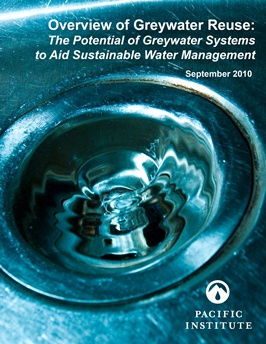
Overview of Greywater Reuse: The Potential of Greywater Systems to Aid Sustainable Water Management
Authored By:
Lucy Allen, Pacific Institute
Juliet Christian-Smith, Pacific Institute
Meena Palaniappian, Pacific Institute
As the need for freshwater resources grows and new supplies are becoming scarce, many communities around the world are exploring different ways to meet their local water needs. Greywater reuse can be an important strategy in this effort when used near to the generation point, it can significantly reduce demand for freshwater and energy use. Learn more about what greywater can do for your community from our partners at the Pacific Institute.
Roadmap for Sustainable Water Resources
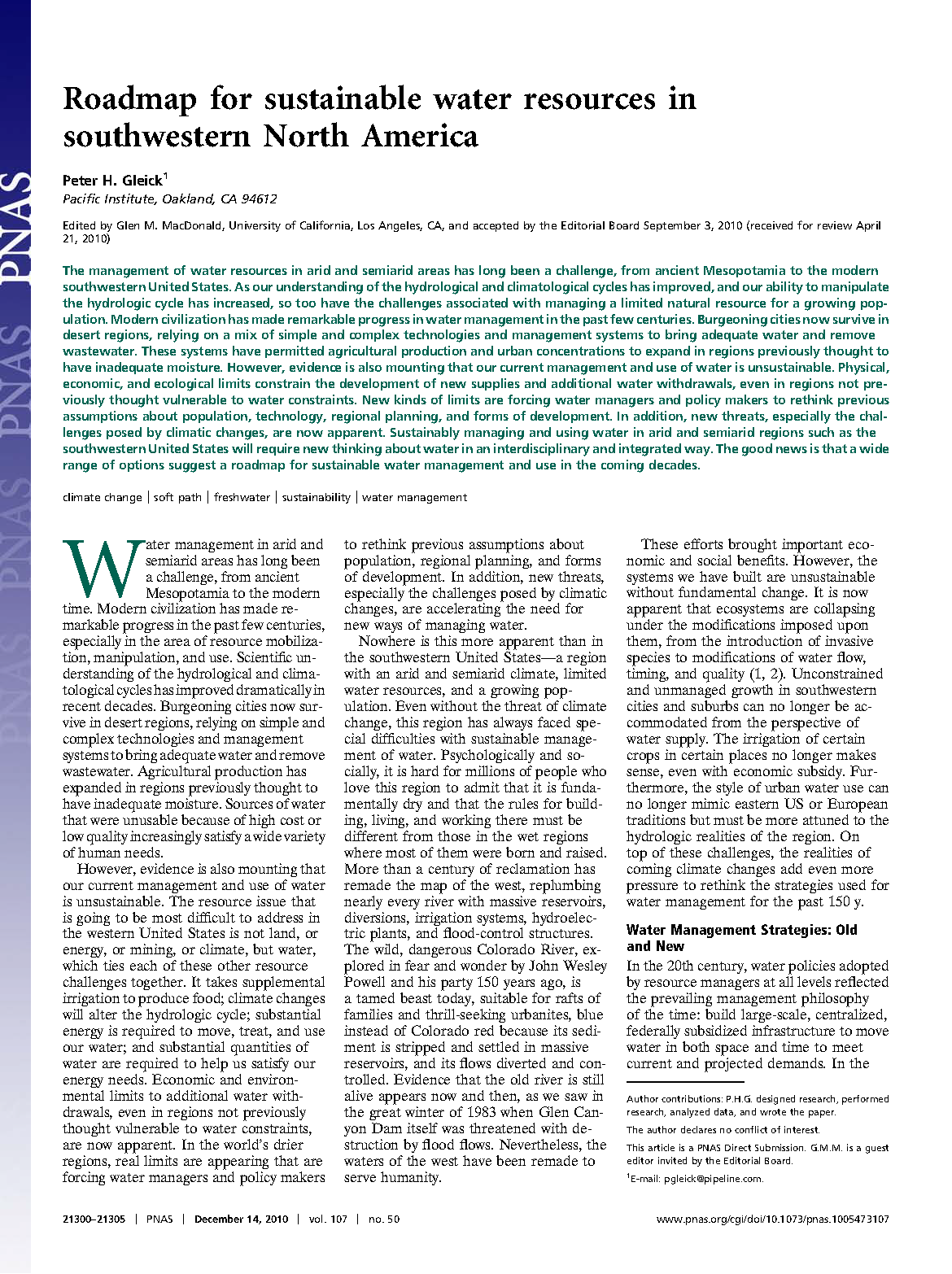 Roadmap for Sustainable Water Resources: New Article by Peter Gleick Addresses Challenges and Strategies
By Peter Gleick, Pacific Institute
This article published in Proceedings of the National Academy of Sciences dives into four key strategies for water managers, planners, and utilities to address in order to tackle the water problems facing the Southwest of the United States. By (1) rethinking our water assumptions, (2) working to reduce demand, (3) improving water management, and (4) addressing climate change implications on our water systems, we will be ready to create a roadmap towards a more sustainable water future.
Municipal Deliveries of Colorado River Basin Water
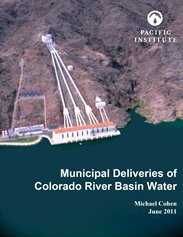 Municipal Deliveries of Colorado River Basin Water: New Report Examines 100 Cities and Agencies
Authored by: Michael Cohen, Pacific Institute
This report by our partners at the Pacific Institute documents population and water delivery for 100 cities that receive water from the Colorado River basin. Since the 1990s, the number of people dependent on the Colorado River has massively increased while water use has decreased. This report dives into these numbers and trends, and the water-efficiency trends seen across the West.
The Untapped Potential of California’s Water Supply
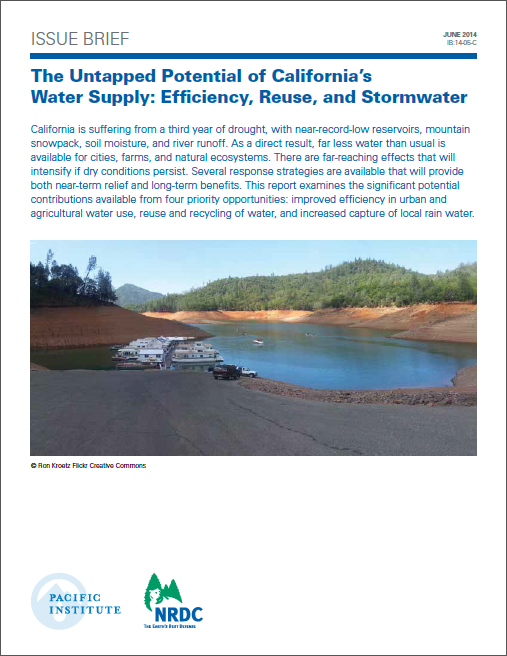 The Untapped Potential of California’s Water Supply
Authored by: Pacific Institute and Natural Resources Defense Council
According to our partners at the Pacific Institute and their research partners at the Natural Resources Defense Council, California could be saving up to 14 million acre-feet of untapped water with increased water management efforts. By increasing statewide use of water saving practices,water reuse, and stormwater capture, California could save more than the amount of water it currently uses per year.
Metering in California
 Metering in California
Authored by:
Kristina Donnelly, Pacific Institute
Heather Cooley, Pacific Institute
This white paper by our partners at the Pacific Institute dives into water meters and their essential nature in water management, particularly during drought conditions. “Metering is an essential tool for water management and expanding and improving metering should be a priority for all California utilities,” said Kristina Donnelly, lead author of the study. “While the water savings from metering all connections in California will not create large volumes of water statewide, they can produce considerable local water savings.” Check out this white paper to learn more.
Water Use Trends in the United States
 Water Use Trends in the United States
Authored by:
Kristina Donnelly, Pacific Institute
Heather Cooley, Pacific Institute
Water use across the United States dropped remarkably since 2000, to rates now lower than the 1970s. This trend has continued despite population and economic growth throughout the nation. This report from our partners at the Pacific Institute analyzes and explains these trends, and discusses what must continue to be done to meet water needs of the future.
Incentive-based Instruments for Freshwater Management
Incentive-based Instruments for Freshwater Management
Authored By:
Heather Cooley, Pacific Institute
Michael Cohen, Pacific Institute
Matthew Heberger, Pacific Institute
Heather Rippman, Pacific Institute
This report from our partners at the Pacific Institute provides a review of incentive-based instruments - water trading, payment for ecosystem services, and water quality trading - around the world. The report and interactive tools help communities to align the right water management tools with their water goals.
The Cost of Alternative Water Supply & Efficiency in California
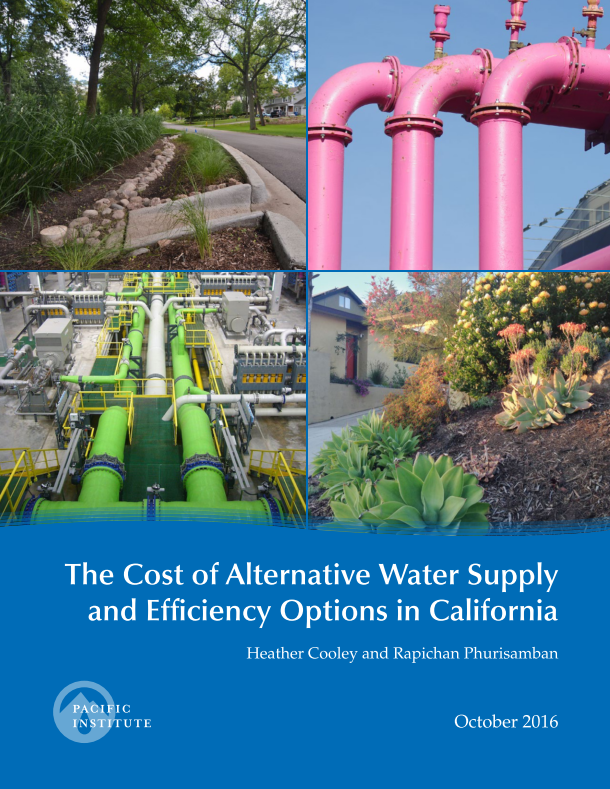 The Cost of Alternative Water Supply and Efficiency Options in California
Authored By:
Heather Cooley, Pacific Institute
Rapichan Phurisamban, Pacific Institute
This report from our partners at the Pacific Institute is an analysis of the cost of various strategies throughout the state of California to explore other local water supplies and reduce water demand from urban communities. The report compares the cost and effectiveness of popular supply alternatives such as desalination, large stormwater recapture, onsite non-potable reuse, and water conservation and efficiency.
Accelerating Cost-Effective Green Stormwater Infrastructure
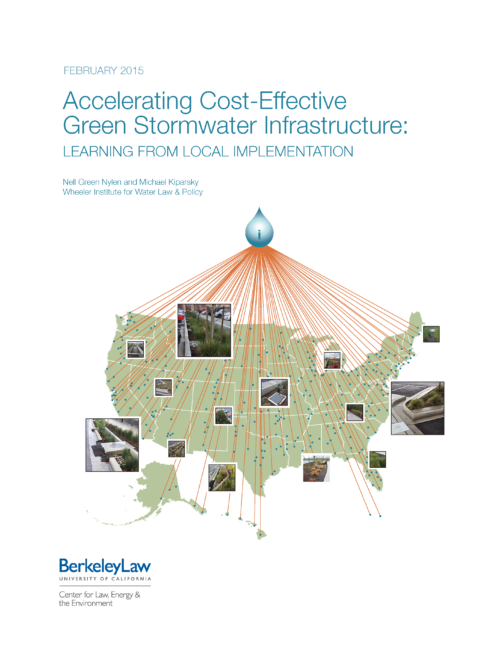 Accelerating Cost-Effective Green Stormwater Infrastructure: Learning from Local Implementation
Authored By:
Nell Green Nylen and Michael Kiparsky, Wheeler Institute for Water Law & Policy
"Conventional stormwater management strategies based around “gray” collection and conveyance systems— networks of gutters, storm drains, and sewers—have not solved persistent stormwater problems. Instead they have shifted, and in many cases exacerbated, the impacts of stormwater runoff, trading urban flooding for pollution and hydromodification of nearby rivers, streams, lakes, and estuaries.
Green stormwater infrastructure (GSI) is an important part of the solution. A different approach to stormwater management is needed. Effective management requires a holistic approach that employs a locally tailored mix of on-site and off-site retention, treatment, and use along with pollutant source controls to protect local waters and meet other community and regulatory objectives."
Legislative Options for Financing Water Infrastructure
Legislative Options for Financing Water Infrastructure
Authored By:
Claudia Copeland, Specialist in Resources and Environmental Policy
Steven Maguire, Section Research Manager
William J. Mallett, Specialist in Transportation Policy
"This report addresses several options considered by Congress to address the financing needs of local communities for wastewater and drinking water infrastructure projects and to decrease or close the gap between available funds and projected needs. Some of the options exist and are well established, but they are under discussion for expansion or modification. Other innovative policy options for water infrastructure have been proposed, especially to supplement or complement existing financing tools. Some are intended to provide robust, long-term revenue to support existing financing programs and mechanisms. Some are intended to encourage private participation in financing of drinking water and wastewater projects."