A Handbook for Understanding Natural Capital
 What is your Planet Worth? A Handbook for Understanding Natural Capital

Authors:
Allyson Schrier, Earth Economics
Justine Bronfin, Earth Economics
Jennifer Harrison-Cox, Earth Economics
This handbook explores and explains the relationship between human economies and natural systems, and provides an understanding of the historic disconnect between the environment and the economy. It introduces new tools and principles that recognize the economic importance of our planet’s natural systems and provides mechanisms to foster the changes needed to preserve our planet’s precious natural resources.
LIFT-UP Financial Empowerment through Utility Payments
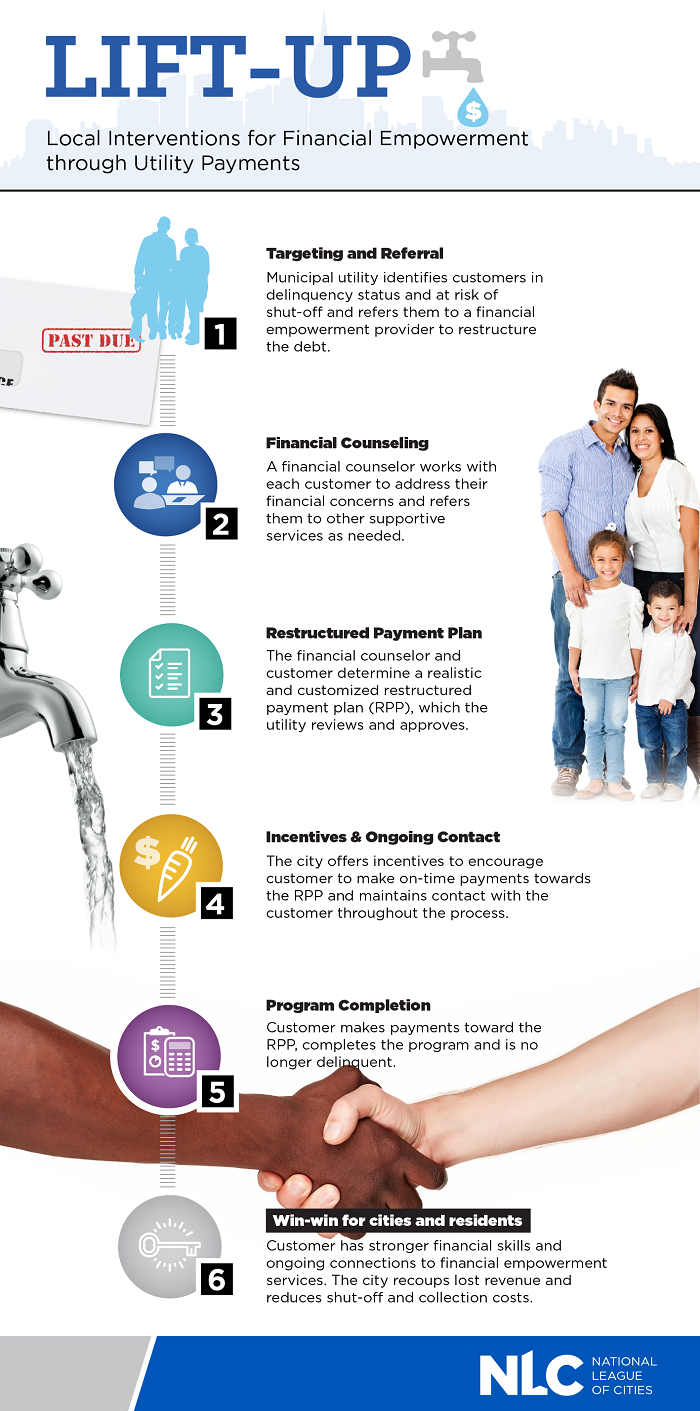 Implementation and Impact Evaluation of Local Interventions for Financial Empowerment through Utility Payments (LIFT-UP)
Prepared for The National League of Cities Institute for Youth, Education, and Families
Report By:
Stephanie Moulton*, The Ohio State University, CFS Affiliate
Danielle Harlow, The Ohio State University
Olga Kondratjeva, The Ohio State University
Stephanie Casey Pierce, The Ohio State University
"When families fall behind on payments for basic necessities like water, it may be a sign of financial instability. Local Interventions for Financial Empowerment through Utility Payments (LIFT-UP) is a model that targets families who have missed payments to utilities or other municipal entities and offers FE interventions at the onset of the debt collection process. LIFTUP is designed to reconcile a “missed opportunity” to connect residents who are struggling to pay for municipal debts, like water utility bills, with FE services."
Check out this report from our partners at the National League of Cities (NLC) on the impact and effectiveness of such programs.
Connection Charges: Encouraging Water Efficient Growth
Water Connection Charges: A Tool for Encouraging Water-Efficient Growth

Authored by
Amelia Nuding, Western Resource Advocated
Sharlene Leurig, Ceres
Jeff Hughes, UNC
One of the greatest challenges facing many U.S. communities today is supporting a growing population with limited water resources. Conservation is widely acknowledged as a critical part of the solution, but often utility conservation efforts are heavily focused on existing customers and ignore new customers at the crux of the challenge. This report from our partners at Ceres highlights the extent to which water connection charges are encouraging water-saving design in new construction and landscaping before ground is broken.
Bond Financing Distributed Water Systems
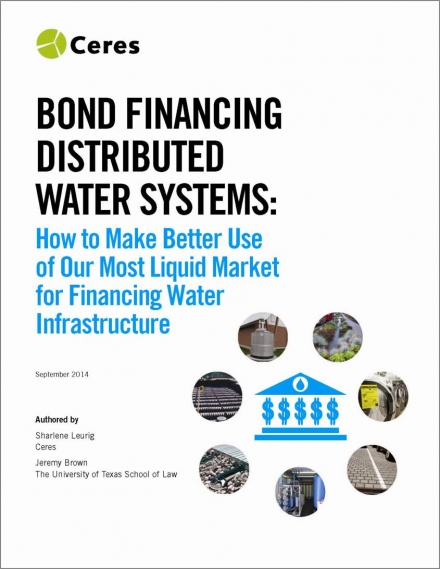 Bond Financing Distributed Water Systems: How to Make Better Use of Our Most Liquid Market for Financing Water Infrastructure
Authored by
Sharlene Leurig, Ceres
Jeremy Brown, The University of Texas School of Law
As extreme weather events exacerbate challenges already faced by communities across the US - flooding, drought, water quality issues - green and “distributed infrastructure” (DI) programs can be an important part of how water agencies address these challenges. Smaller scale, localized programs perform the same functions as traditional infrastructure, safeguarding water supply and quality, protecting ecosystems, and managing urban runoff. Additionally, they’re often less expensive and easier to implement than conventional alternatives.
This report, by our partners at Ceres, explores how to make better use of current market mechanisms for these water solutions in order for all water utilities - drinking, waste, and storm - to provide reliable, reasonably priced water services now and into the future.
Why Water Efficiency is the Best Solution for the Southeast
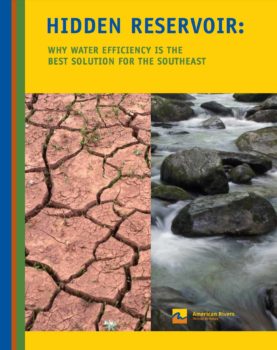
Hidden Reservoir: Why Water Efficiency is the Best Solution for the SouthEast
A publication of American Rivers Inc.
The Southeast United State faces extreme water supply challenges - which have been exacerbated due to growing populations and the impacts of climate change. Much of the 19th and 20th-century solutions to these challenges have been dams, but 21st-century challenges require 21st-century solutions.
This report, by our partners at American Rivers, explores how water efficiency can be our best source of affordable water and must be the backbone of water supply planning.